Transforming The Land - One Garden at a Time
Originally in The Race, Poverty and the Environment Journal Published by Urban Habitat Community gardening is finally becoming recognized as a way to sustain a healthy environment, encouraging us to think globally and eat locally.
This is featured post 2 title
Replace these every slider sentences with your featured post descriptions.Go to Blogger edit html and find these sentences.Now replace these with your own descriptions.This theme is Bloggerized by Lasantha - Premiumbloggertemplates.com.
This is featured post 3 title
Replace these every slider sentences with your featured post descriptions.Go to Blogger edit html and find these sentences.Now replace these with your own descriptions.This theme is Bloggerized by Lasantha - Premiumbloggertemplates.com.
Thursday, April 7, 2011
Tuesday, November 16, 2010
Civil Rights Artivism at its Finest
Posted by Pops' Campaign on 3:34 PM
Remembering Oscar Grant, Political Prisoners
Operation Small Axe DVD Release Party w/ Emory Douglas
A night with the iconic artist Emory Douglas and the screening of Operation Small Axe documentary set the tone for National Anti-Police Brutality Day over the weekend.
Documentary Operation Small Axe highlights the anti-sentiment that Oakland residents have towards the Oakland Police Department and goes as far as describing the City of Oakland as a “war torn prison state.”
“The police have been so vicious and so brutal to our black brothers in this society,” stated the documentary’s producer, Adimu Madyum.
The documentary hosts a series of revelations including the state of neutrality the black Oakland Mayor Ron Dellums and city officials have taken, the mainstream media downplaying the significance of the possible martyr Lovelle Mixon who killed four police officers a few months after the death of Oscar Grant, the slaying of DeAndre Brunston and the fight journalist JR is facing to drop charges that claim he was participating in the Oakland city riots while in actuality he was reporting on the event.
The fact that former Black Panther and Minister of Culture, Emory Douglas and the grandson of the influential Malcolm X, Malcolm Shabazz were in attendance added to the importance of holding the police accountable for brutality against African American men in particular.
“Its unfortunate that we are still fighting for the same thing that my grandfather was fighting for during the civil rights era,” said 26-year-old Shabazz. “But at the core of the police system there is still bigotry and racism.”
If one ever doubted that the cops have very little disdain for black youth all confusion was cleared up when the documentary clipped to the scene of the tragic murder of Deandre Brunston, 24, that was caught on tape. Brunston’s standoff with the police, on August 24, 2003, lasted about 20 minutes before they released a dog to attack him, when Brunston threw a shoe at the dog the police began shooting. He was shot 22 times and a few bullets hit the police dog as well. The backward and inhumanity of the police force allowed for the police dog to be airlifted in an emergency helicopter while Brunston was left to die. You can see in the video that Brunston was still moving after the police shot him. His aunt, Keisha Brunston was never released from the back of the cop car to calm him to down or make him surrender. She has been present in the Oscar Grant case and has supported the family through the trail.
“Stop killing us,” said JR in reference to police brutality. “We want police to know that we are watching them and we are holding them accountable.”
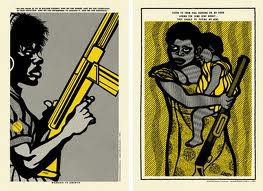
The night ended with revolutionary artist, Emory Douglas, providing commentary and insight into his prolific drawings during his time with the Black Panther newspaper. He also spoke about artivism, defining a political agenda by the means of art. He put emphasis on the fact that Black Panthers were all over the world in places such as Israel, Australia and New Zealand. He explained why he depicted the police as pigs and cleared up the myth that the Black Panthers were not against all white people but the racist police system.
“We shall survive without a doubt,” “Freedom on my mind,” and “all power to the people” were just a few slogans that were emblazoned on Douglas’ colorful pieces depicting the struggle that black people went through in every day life.
Douglas got started in the Black Panthers while attending rallies at San Francisco State University and City College of San Francisco where he studied commercial art, art geared toward advertising. He remembers learning from one of his professors that “you should be able to draw in a way that a child will understand.” Instead of going a route that some commercial artists go by advertising cigarettes or alcohol Douglass chose a righteous path of arming people in low-income neighborhoods with knowledge as he provided kids with clothing and free vegetables. Children are representative quite often in Douglas’s artwork.
“The Black Panther Party was formed to defend our community and put a stop to police atrocities,” said Douglas during his presentation. “Currently, our black youth are still marginalized and unable to get a job so they are doing what they have to do to survive.”
The evening took place at the Twin Space Continuum at 17th and Mission on October 22, 2010.
Wednesday, September 1, 2010
Thursday, August 26, 2010
Monday, August 9, 2010
Deconstructing... The Boondocks
Posted by Pops' Campaign on 1:56 AM
We always wondered why Uncle Ruckus hated black "or his own" people so much. This episode before the season finale explains it all.
When Ruckus was a baby he was left on the steps of a black family's house because his original white family (racists) saw that he was beginning to form darker skin. They showed a birthmark on baby Ruckus and it very well looked like he was turning black. Ruckus' soon-to-be parents (a woman who wants to be 'white so bad that she made her hair blonde and eventually colored her eyes blue and a father who is happy that money was attached to the offer) decided to take him.
"This ain't no regular baby, this is a WHITE baby," said the adoptee's mother. "It's the most beautiful thing in the whole wide world."
Ruckus' family saw him as a Godsend and a chance to get a piece of the "white man's glory." When they were celebrating his arrival the confederate flag hung strong in the background. The symbol of the Confederate flag is a piece of history that some Americans are tragically still proud of. The confederate flag is a symbol still used by nazis and KKK members as a reminder that they slowed down the process of black folks right of freedom while the north moved ahead.
At a young age Ruckus began to turn black. His mother called it a case of re-vitiligo (the reverse of what happened to Michael Jackson's skin post "We Are the World.") Ruckus began to hate most black people and blamed all of his shortfalls on the color of his skin.
The story proceeds with the death of this grandmother and painful memories of his family's past.
Riley said that he was getting emotional from Uncle Ruckus' story but reiterated that he wasn't going to "cry because he wasn't gay." He ended up crying in the end. Riley is a hopeless mimic of black straight man media and culture and it plays out in his every move. Its entertaining but on the same token he is blind to reality. He needs to read some Frederick Douglass, Franz Fanon, Malcolm X.
Ruckus closed the scene by stating even though him and his family made amends he still concluded by saying that black people are "hopelessly inferior to white folks." Old habits are hard to kick.
Sunday, August 8, 2010
Hip-Hop is coming out!
Posted by Pops' Campaign on 9:25 AM
On August 4, U.S. District Chief Judge Vaughn Walker rules that Proposition 8, the California initiative passed in November 2008 that banned same sex marriage, was unconstitutional. At around the same time, bloggers revealed that our beloved Queen Latifah was spotted off the coast of France and Italy getting lovey with her personal trainer. Along with Latifah's outting, Supreme Court Justice Sonia Sotomayor was confirmed into the Supreme Court.
Since the beginning of gay rights activism that started with Stonewall in New York and Harvey Milk in San Francisco I am happy to see that love is slowly but surely becoming more normalized.
There are still 76 countries that criminally prosecute homosexual acts, according to a recent study; seven of the nations impose the death penalty.
The decision was a result of a lawsuit filed by two same-sex couples who claimed that Prop 8 infringed their constitutional rights. Voters had originally approved the ban in response to a California Supreme Court ruling that temporarily legalized same-sex marriage in the state. Walker's decision is expected to be appealed and to eventually make its way to Supreme Court. Currently five states and the District of Columbia allow same sex marriage.
Since the beginning of gay rights activism that started with Stonewall in New York and Harvey Milk in San Francisco I am happy to see that love is slowly but surely becoming more normalized.
There are still 76 countries that criminally prosecute homosexual acts, according to a recent study; seven of the nations impose the death penalty.
The decision was a result of a lawsuit filed by two same-sex couples who claimed that Prop 8 infringed their constitutional rights. Voters had originally approved the ban in response to a California Supreme Court ruling that temporarily legalized same-sex marriage in the state. Walker's decision is expected to be appealed and to eventually make its way to Supreme Court. Currently five states and the District of Columbia allow same sex marriage.